Authentic lederhosen are made from full-grain leather with hand-stitched construction. Costume lederhosen use polyester or thin split leather. The authentic lederhosen differ significantly from the costume versions in quality and fit. Finding a genuine lederhosen made with quality materials is very hard.
Every year, around August, the market is flooded with trachts with Lederhosen selling for $24.99 and complete Oktoberfest sets for $34. Thousands of them, all described as “authentic,” “traditional,” and “Bavarian.” Most of them are polyester.
The problem is not that cheap versions exist. The problem is that buyers who have never seen a genuine pair have no frame of reference to compare. You order something that looks fine in a product photo, it arrives, and either you cannot tell the difference or you wear it once and the surface starts cracking at the knee.
Authentic Lederhosen vs Costume Lederhosen
Lederhosen men are historical garments that differ from everyday costumes, featuring technical aspects like real leather material, embroidery motifs tracing back to the Alpine culture, and drop flap closure. Costume lederhosen are stiff as they are made of synthetic material and lack technical detailings.
Authentic Lederhosen |
Costume Lederhosen |
|
Material |
Genuine goatskin, deerskin, or cowhide. Each has a distinct texture and weight. |
Synthetic PU, faux suede, or thin cotton blend. |
Embroidery |
Hand-embroidered or precision machine-embroidered Alpine motifs in wool or silk thread. |
Printed-on patterns or loose stitching that puckers and fades. |
Construction |
Hand-cut panels, reinforced seat and thigh seams, lined waistband. Built to last years of wear. |
Machine-sewn with minimal reinforcement. Seams separate after a few hours of real wear. |
Local reception |
Locals recognize quality leather. Wearing authentic pieces signals respect for the tradition. |
Spotted immediately. The sheen of synthetic fabric and printed decoration are giveaways. |
Where to Buy |
German heritage brands, specialist Tracht retailers, established online stores |
Party shops, costume retailers, fast fashion platforms. Often sold in plastic packaging. |
Features that Differentiate a Genuine Lederhosen from a Cheap One
Some features are visible on the lederhosen that signifies their authenticity. A keen eye can readily differentiate between a costume and Authentic lederhosen.
The Leather Itself: Real or Synthetic
Genuine lederhosen pairs are made from animal hide. Deerskin, goatskin, and cowhide are the three most common options. Deerskin is the softest, lightest, and most expensive. Goatskin has a slightly rougher texture, holds up well in outdoor conditions, and costs less. Cowhide is the stiffest of the three when new, takes longer to mold to the body, but becomes some of the most characterful leather once it does.
Costume versions use synthetic leather, polyester, or faux suede. These look reasonably similar to genuine leather in photographs, which is why it is hard to tell them apart from genuine leather.
How to Tell Real Leather Apart?
- See it: Analyze the lederhosen featured by genuine Bavarian outfits stores like Lederhosen Store. They have a natural grain pattern that varies unevenly across the garment. Synthetic leather has a uniform pattern throughout because it is embossed by a machine.
- Smell it: Genuine leather has a warm, slightly earthy scent. Synthetic material smells like the inside of a plastic bag. If the product photo listing says “genuine leather” and the package smells chemical when it arrives, send it back.
- Squeeze a section: Real leather wrinkles when you grip it and relaxes slowly when you let go. Fake leather resists, stays flat, and has no memory of the grip because it has no fiber structure.
- Hold it against your hand: Real leather picks up warmth from skin contact within seconds. Synthetic material stays at room temperature.
The Seams: Visible vs. Hidden
This is the detail almost no buying guide mentions, and it is one of the most reliable quality signals on a genuine pair.
Säcklernaht Technique of Authentic Lederhosen
Traditional lederhosen feature a construction technique called the Säcklernaht. This technique involves a visible seam on the outside of the garment along the side panels and leg. Leather edges are stitched together with a light-coloured leather strip sewn between them, creating a raised, visible seam that is both structural and decorative.
Costume versions use standard machine stitching, hidden on the inside, sewn as fast as possible. Flip the garment inside out and look.
Uneven stitching of handmade lederhosen
One more thing on stitching: hand-sewn seams are not perfectly uniform. Slight variation in spacing and tension is the result of a human hand, not a flaw. If every stitch is machine-perfect, it was machine-made.
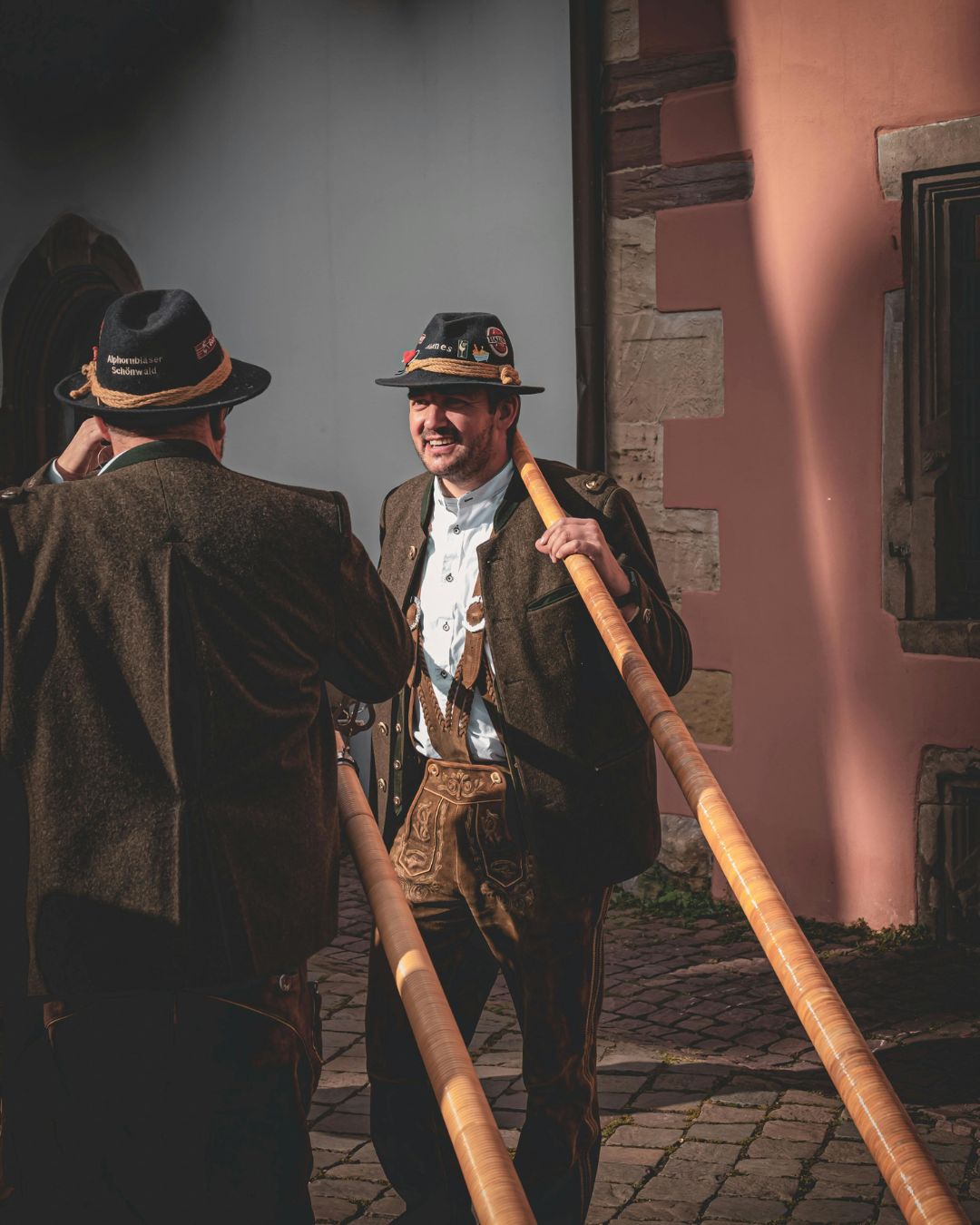
The Embroidery: Hand-stitched vs. Machine
The embroidery on a genuine pair is hand-stitched, with thread guided through the inside of the hide. Traditional Bavarian motifs like Edelweiss, stag, oak leaf, and Antlers each carry regional significance going back centuries in Bavarian craft.
On the other hand, machine embroidery sits on the surface and repeats identically across every unit because it was stitched by a machine. The embroidery is uniform and as time passes it lifts from the fabric.
Embroidery placement on lederhosen
Embroidery placement is another indicator of genuine lederhosen. On a genuine pair, embroidery appears on the Hosenlatz (the front flap), the bib, the pockets, and often extends down the leg toward the cuff. Most costume versions have a single embroidered band across the bib and nothing beyond that.
The Buttons: Staghorns vs Plastic Made
Real staghorn buttons come from antler. Every button looks slightly different because the natural horn has variation in colour, grain, and density across the material. No two are identical. Plastic buttons moulded to look like horns are perfectly uniform, and the surface has a slight synthetic sheen that real horn does not.
The buttonholes matter as much as the buttons. On a genuine pair, the edges of each buttonhole are reinforced with embroidered stitching. The front flap closes and opens repeatedly over years of wear, and the buttonhole takes that stress. Costume versions cut plain buttonholes with no reinforcement. They start fraying within a season.
The Front Flap: Sewn-in Functional Vs Only Decorative
The Hosenlatz is the large buttoned panel that covers the front of the trousers from the waist down to mid-thigh. It is a functional structural feature carried forward from the original construction of these garments and one of the most recognizable things about them.
Costume manufacturers do one of two things: they sew a flat decorative panel that looks like a front flap from a distance but does not open or function, or they skip it entirely and put a zip fly behind a stitched panel. A real Hosenlatz button is closed with horn buttons, sits flat against the garment, and usually has S-shaped embroidery called S-Laub running along the outer leather strip. Replicating this properly requires significantly more material and labour than a zip fly with a fake panel, which is exactly why most costume versions do not bother.
The Lining: No lining Vs Polyester Lining
Authentic lederhosen leave the inside of the garment as an uncoated hide. No polyester lining, no synthetic backing. The raw leather sits directly against your skin, picks up body heat, and softens through the natural movement of wearing. After a few hours, it stops feeling stiff and starts feeling like it belongs to your body.
Costume versions add a polyester lining because it is faster and cheaper to produce. The lining insulates the synthetic outer material from the skin and prevents any of the breathability that real leather provides. By mid-afternoon at a festival, the difference between a lined synthetic garment and an unlined leather one is hard to ignore.
What to Look For in Lederhosen Product Listing?
Most of these differences between authentic and costume lederhosen show up in descriptions and photographs. By thoroughly going through the description, you can make the right choice.
- On material: Look for a specific hide named. Deerskin, goatskin, buckskin, cowhide. Any listing that uses “premium material,” “high-quality fabric,” or “leather-look finish” without specifying the hide is telling you something.
- On embroidery: “Hand-stitched,” “hand-embroidered,” or “Stickerei” indicates genuine work. “Embroidered accents” or “decorative embroidery” without qualification usually means machine work.
- On buttons: “Staghorn buttons,” “genuine horn,” or “natural horn” is what you want to see. “Decorative hardware” or no mention of buttons at all is not.
- On price: A full set with suspenders under $80 is not genuine leather. Deerskin costs more per square foot than that before a single stitch.
- On photographs: Real leather has visible surface variation and slight depth. The grain is not uniform. Costume versions photograph flat and slightly shiny, with a surface texture that repeats.
Why the costume Lederhosen Exist
Oktoberfest is now a global event. Cities across the US, Australia, Canada, and Europe run their own versions, and demand for something to wear far exceeds what traditional Bavarian workshops can produce. Mass manufacturers stepped into that gap with garments made from synthetic materials, produced cheaply and sold under words like “authentic” and “traditional” that carry no legal definition.
Real lederhosen made from genuine leather start around $100 for basic goat suede. Deerskin runs above $200. A complete set with suspenders at $35 is not leather. The price tells you that before you read a single word of the description.
Conclusion
Genuine leather softens and shapes to your body with wear. A pair of leather breeches used regularly across five or six Oktoberfest seasons looks more traditionally dressed than a brand-new stiff pair, because a worn-in patina is part of what makes the garment what it is.
Costume leather does the opposite. PU surface finishes degrade under repeated stress. Most do not make it past two or three wears before the material starts to peel at the knee or waistband. A genuine pair, regardless of who is wearing it, signals care and respect. A costume version signals the opposite, no matter how much effort went into the rest of the outfit.