Before you crack open a single paint pot, getting your workspace right matters more than most beginners ever anticipate. A cramped table, poor lighting, or paints scattered across three different surfaces can turn what should be a calm, enjoyable session into a genuinely frustrating one.
You don’t need a dedicated art room, a professional easel, or pricey equipment to paint well at home. What you do need is a thoughtful setup that keeps your materials within reach, your light consistent, and your body comfortable enough to sit for an hour or two without aching.
This guide covers every element of how to set up the perfect paint by numbers workspace at home, beginning with location and moving through lighting, surface choice, supply organization, and comfort. Each decision is simple and reversible, so adjusting as you go isn’t a problem. Get the basics in place first, and the painting itself becomes far more enjoyable from the very first number you fill in.
Choosing the Right Spot: Light, Space, and Surface
The foundation of how to set up the perfect paint by numbers workspace at home is picking a location that genuinely supports the work. Many painters browse custom paint by numbers sets before they’ve given any thought to where they’ll actually sit down and paint, which tends to lead to a makeshift arrangement that gets abandoned within a week.
Your location doesn’t have to be permanent, but it does need to meet a few conditions: enough flat surface area to hold your canvas, paints, water cups, and reference sheet without stacking anything on top of anything else; a light source you can control; and a chair or seating position that keeps your back supported.
A kitchen table near a window, a desk in a spare bedroom, or a folding table set up in a living room corner can all work well. What matters is consistency. Painting in the same spot every time means your eyes adjust to the same light, your supplies stay in the same place, and you spend less time setting up and more time actually painting.
Getting the Lighting Right
Lighting is probably the single biggest factor in how accurately you can follow the numbered sections on your canvas. Natural daylight from a north- or east-facing window gives you the most neutral, consistent color rendering, but it shifts throughout the day and vanishes entirely by evening.
Most people paint at night, which means artificial light is unavoidable for a good chunk of your sessions. A daylight LED bulb rated between 5000K and 6500K on the color temperature scale replicates natural light well enough that colors stay true and the small printed numbers on the canvas stay easy to read.
Position the light source to your left if you’re right-handed, or to your right if you’re left-handed, so your painting hand doesn’t cast a shadow across the section you’re working on.
Overhead lighting alone tends to flatten the canvas and produce glare; a dedicated desk lamp angled at roughly 45 degrees works considerably better than relying on a ceiling fixture. A clip-on lamp with an adjustable neck is inexpensive and does the job well.
Picking a Stable, Comfortable Surface
Your canvas needs to lie flat or sit at a steady angle while you work. One that slides around every time you pick up a brush breaks your focus and can smear paint lines you’ve already laid down. The simplest fix is a non-slip mat under the canvas; a silicone baking mat or even a damp cloth costs nothing and works fine.
If you’d rather paint at an angle than flat, a small wooden board propped up at the back creates a gentle slope that many painters find easier on both the neck and eyes. Table height matters more than most people realize.
Your elbow should rest comfortably on the surface without your shoulder hiking up, which generally means a table between 28 and 30 inches tall paired with a chair that puts your hips at roughly a 90-degree angle.
Too high, and your arm fatigues faster; too low, and you end up hunching forward and straining your lower back. Take five minutes to adjust your chair before your first session.
Setting Up Your Supplies for Easy Access
A disorganized supply area is one of the most common reasons people lose momentum mid-session. Hunting for the right paint color while a freshly loaded brush dries out is maddening, and it kills the meditative quality that makes paint by numbers so satisfying as a hobby.
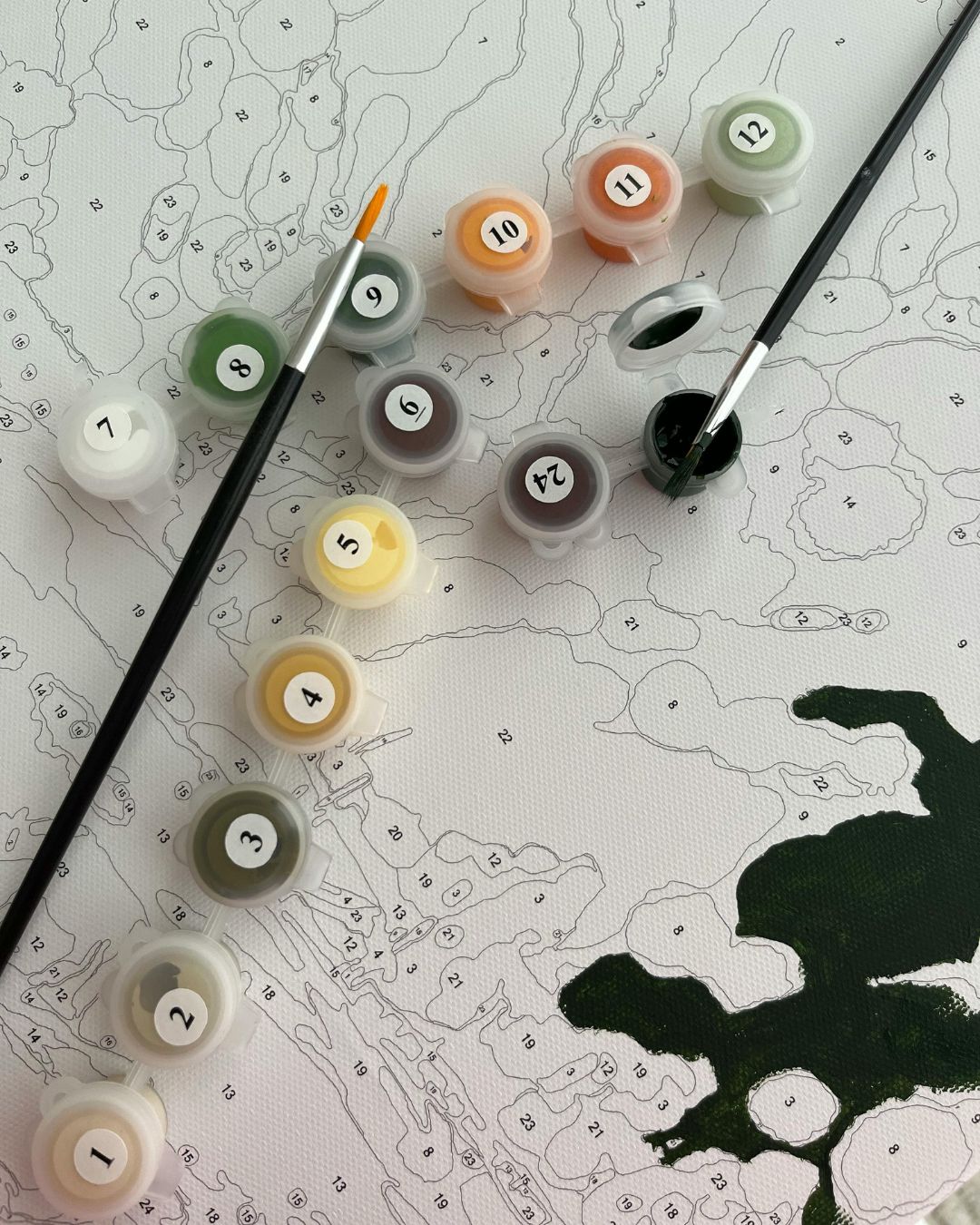
The goal is straightforward: everything you need should be reachable without standing up, and everything you’re not currently using should be out of the way. Group your paints by number or by color family and keep them in a small tray or an egg carton. Push your water cups toward the back of the surface to reduce the chance of knocking them forward onto the canvas.
A small piece of wax paper or a ceramic plate makes a perfectly adequate mixing palette if a color needs thinning. Keep a roll of paper towels or a stack of clean cloths within arm’s reach, because blotting a misplaced stroke quickly is far easier than correcting dried paint later.
How to Organize Your Paints and Brushes
The numbered paint pots that come with most kits are small, and they look similar enough that reaching for the wrong one mid-session is easier than you’d think. A few simple organizational habits prevent this from becoming a regular problem:
- Line them up in numerical order from left to right in a shallow tray or box so you can find any number at a glance.
- Keep only the colors you’re actively using in the current session at the front of your workspace, and move finished pots to the back or a separate holding area.
- Sort your brushes by size – smallest to largest – and keep them upright in a cup or laid flat on a folded cloth so the bristles don’t splay.
- Cap paint pots immediately after use. Acrylic paint dries fast, and an open pot left while you work on another section can thicken to the point where it needs water to recover.
- Rinse brushes between every color change, not just when switching to a dramatically different shade. Cross-contamination between similar colors is subtle but visible once the paint dries.
Spending five minutes at the end of each session to reset your layout means you don’t start the next session with a cluttered surface and dried-out pots.
Protecting Your Space and Staying Comfortable
Paint drips happen to everyone, and acrylic paint bonds to fabric and unfinished wood fast. Lay a plastic tablecloth, a sheet of paper, or an old bedsheet over your working surface before you set anything else down. That one step protects your table and cuts cleanup time considerably.
Cover the floor below your workspace with a drop cloth if you’re working over carpet or hardwood you care about; a stray brush swipe or a tipped water cup reaches the floor faster than you’d expect. Beyond surface protection, your physical comfort during a session directly affects how long you can paint without fatigue.
Take short breaks every 30 to 45 minutes – stand up, stretch your hands and shoulders, and rest your eyes by looking at something across the room. Keeping a glass of water nearby isn’t just for rinsing brushes; staying hydrated during focused creative work genuinely helps concentration.
The right setup for how to set up the perfect paint by numbers workspace at home isn’t only about the materials – it’s about making the experience sustainable and something you actually want to come back to.
Conclusion
A well-planned workspace clears away the small friction points that pull you out of the creative flow when you paint by numbers. Good light, a stable surface, an organized supply layout, and proper surface protection combine to create an environment where the painting itself gets your full attention.
None of these changes cost much or take long to put in place, but each one makes a noticeable difference the first time you sit down to work.
Start with location and lighting, then build your supply organization around the specific kit you’re using. You’ll refine things as you paint more and develop your own preferences, but even a basic version of this setup beats an improvised one every time.